

Dear Joe, this is about trying and dying. Hope you like it.
YOU ARE DYING UP THERE, FLORA. Can you hear that? WE ARE NOT LAUGHING.
This was our teacher calling out over an uncomfortably loud country music track, which she had looped back to the beginning twice now because poor, poor Flora was still up on stage and still hadn’t made us laugh.
She was given nothing by the teacher; no props, no scenario to play in, no warning of the country music. She was just told to get up with her red nose on. This was week two of a 6 days-a-week, 5-week-long, clowning workshop that I had paid a lot of money to be on; we weren’t even halfway through, but we were expected to be capable of being funny (or at least entertaining) by now.
Flora had been trying, hard. She had been opening and closing windows, marching and dancing about the studio, she even tried to use her water bottle as a prop for inspiration. But the life had been sucked out of the whole room, we were all uncomfortable and very bored.
At minute 7 on stage with nothing to do, Flora looked as though she might burst into tears. Flora, you are flopping hard, the teacher again. I KNOW. I DON’T KNOW WHAT TO DO she shouted back, which to be fair to her, did get a small laugh.
It was incredible and a bit alarming to me, to be witnessing someone in so much visible distress while feeling a sense of gap, of nothingness, towards them. As a group we wanted Flora to succeed, she had got up on stage to try! But at the same time, a feeling of deadness amongst us was palpable.
The most shattering thing about those violent endings was the feeling of being so publicly alone. (This does come good, just give it a minute.) Imagine it for yourself; you are in a room full of strangers and you have been told that you need to make them laugh, or at least capture their attention, so you get up in front of these people on your own, with no plan of what you will do, and you try. But it doesn’t work, and all of a sudden this room full of people is staring at you blankly, and a teacher is telling you, in front of everyone, that what you are doing is not working, and you experience a strange kind of black hole that you didn’t know existed in your mind. In this black hole, you lose touch with all sense of self, logic, reason, and, worst of all, it is where you lose all sense of play. You die in a big gap where there are people but you can’t get to them and they can’t get to you.
At minute 9 of Flora’s death, something magic happened. She gave up. She stopped everything she was doing and slumped to the floor like a brick. A lost brick. Instantly you could feel the room soften. The teacher stopped heckling for a second, and as a group, we were transfixed by this sad, but very honest clown doing nothing other than looking back at us. Then, she started to play. It was as if she hadn’t heard the music properly until this moment. Like a child caught in their own game, she started to play some bongos that were in the country track (strange track) in thin air. And that was it. We were all jolted into a genuine laugh. It was a funny image. Our laugh surprised the clown so much that she shot up, celebrated her victory, and played the bongos again. This only made the whole thing funnier. The teacher stopped the music and Flora went to take her seat, floating, completely bewildered and as though she had lost a second skin. I felt as though something inside my heart had been well and truly touched. Magic (some real human connection) happened. It was our job as a group then, to try and articulate to her what happened when we laughed and to bring her back into the room.
It was easily a flash of the best clowning I’d see in the whole 5 weeks of school.

The laughter that got me was when it came as a byproduct of being moved by another person; as a spasm, an impulse in the body that recognized another person’s vulnerability. A clown’s joy or pain or fear is everyone else’s business the moment they step on stage. That’s why it’s magic. That’s what I learned. Dying is no fun if you do it alone. I saw great clowning when the clown was able to deliver themselves truthfully, optimistically and playfully, so it could be digested by the bodies in the audience; so we could laugh and then break for lunch. So we could try, and then die again the next day.
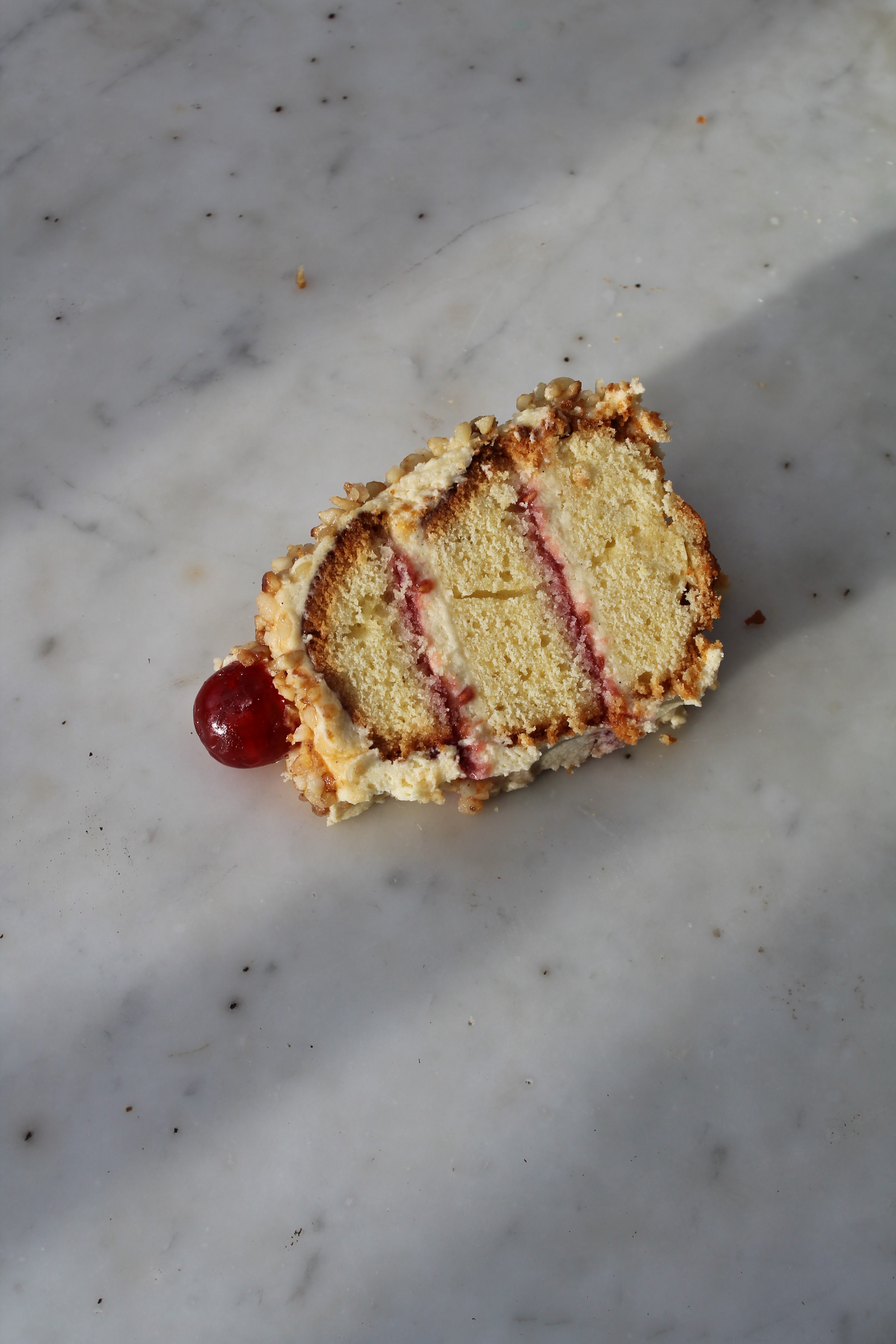
This cake was the only cake that could accompany this letter. I got a slice of it one day at a bakery opposite the studio we worked in. I chose it because I thought it looked the most cake-like cake I could see on the counter, and I needed it to be recognizable in this way because I thought I was going to use it in a sketch that day. I didn’t end up using it as a prop, I just ate it at break. And it was perfect. I picked apart all the components of it and did a lot of googling. What I ate was a Frankfurter Kranz, a German Crown Cake, which is a firm sponge cake made with a bit of cornflour to give it a soft and close texture. It’s flavoured with lemon and almond, baked in a ring, covered with German Buttercream (crème pâtissière whipped with butter), and then coated in caramelized nuts and topped with glacé cherries. What I love about the recipe is that it HAS TO HAVE cherries on top, literally no Frankfurter Kranz recipe ever leaves out the cherries on top.
I’m currently reading Adam Kay’s memoir as a junior doctor, This is Going to Hurt. So, I’m taking the junior doctor mantra ‘see one, do one, teach one’ with this cake: ‘eat one, do one, teach one’. This recipe comes from a very old German baking book I found in Berlin earlier last year, on a free bookshelf on the side of a road. I’ve tweaked it a bit, but the framework is from that book.
Expectation notes – This is a project bake, a project bake that I am very passionate about. The cake is firm, it’s not a light and fluffy situation. The almond and lemon are not flavours you will taste strongly, the lemon juice helps the texture, and the zest and almond extract are adding depth of flavour. The caramelized nuts on the outside may ‘bleed’ a sugary liquid once on the cake – that is ok! It just means your caramel crystalized/seized while you were cooking it – it will still taste great, it just won’t be a crispy outer layer. The cake is best on the 2nd or 3rd day; it does well with resting so is a good one to make ahead, if you’re a planner. Right, I think we’ve covered it all now.
Ingredients
For the Cake
- 200g unsalted butter, softened
- 200g caster sugar
- Pinch of salt
- 4 medium eggs
- The zest of one large lemon, plus 20g of the juice
- 1/2 tsp almond extract
- 200g plain flour
- 100g cornflour, corn strach if you’re in America
- 2tsp / 7g baking powder
For the German Buttercream
- 500 ml milk
- Pinch of salt
- 100g caster sugar
- 100g eggs, this is about 2 medium eggs
- 1 tsp vanilla paste, good-quality extract or the seeds of half a vanilla pod
- 2tbs cornflour
- 2tbs plain flour
- 250g unsalted butter, softened
- 60g icing sugar
For the Nuts
- 200g chopped nuts, hazelnuts or almonds are traditional, mixed nuts are cheaper
- 65g caster sugar
- 35g unsalted butter
For Finishing
- Raspberry or strawberry jam
- Glace Cherries, technically these are optional
Method
Preheat the oven to 190 / 170 fan. Grease and dust with flour a bunt or ring form tin of about 9inch. Cream together the butter, sugar, and salt until fluffed up. Beat in one egg at a time, stopping to scrape down the sides of the bowl in between additions – the more carefully you do this the less likely it is to curdle, but don’t worry if it does, it will come out just fine. Now add the rest of the ingredients; lemon juice and zest, almond extract, plain flour, cornflour, and baking powder. Beat the mixture just until you have a smooth batter. Pour into the prepared tin and bake for about 40-45 mins. Allow the cake to cool completely, ideally resting it overnight.
Make the crème pâtissière for the German Buttercream. Heat the milk, half of the sugar, and salt in a medium saucepan over medium heat. Meanwhile, whisk the rest of the sugar, eggs, vanilla, and both flours in a large bowl. When the milk comes to a simmer, remove from the heat and gradually pour over the egg mixture while whisking vigorously, until all the milk is incorporated. Now pour this mixture back into the medium saucepan. Whisk the custard vigorously over medium heat until the mixture has thickened, then count 30 seconds whisking all the while, and take off the heat. Pour the custard into a clean and dry bowl and cover with cling film, making sure the cling film is in contact with the surface of the custard – this will prevent a skin forming. Allow to chill completely, this could be in the fridge overnight.
To finish the buttercream, whip the butter and icing sugar in a large bowl until very light and fluffy – about 5 mins. Whip the cooled custard into the butter mixture a couple of heaped tablespoons at a time. Don’t worry if your buttercream looks slightly curdled, it’s a hard one to get perfectly smooth and it will be covered with nuts anyway.
Put all the ingredients for the caramelized nuts into a heavy-based pan and heat on medium heat for about 3 minutes, agitating the mixture with a spatula, making sure the nuts don’t burn. When the nuts are as dark as you want, tip out onto a plate or baking tray to cool completely.
Slice the cake into three layers. Reserve a little over a third of the buttercream for the outside of the cake. Fill the layers with a generous amount of buttercream and jam. Coat the whole cake with buttercream reserving a very small amount to stick the cherries on. Cover the cake with the nuts, using your hand to pat them on. Top the crown of the cake with cherries, using the remaining buttercream as glue.
The cake lasts well, at its best even on the 2nd or 3rd day.

I hope you make this cake. Thank you, Flora. Caitlin xxx


















 Cake On My Face